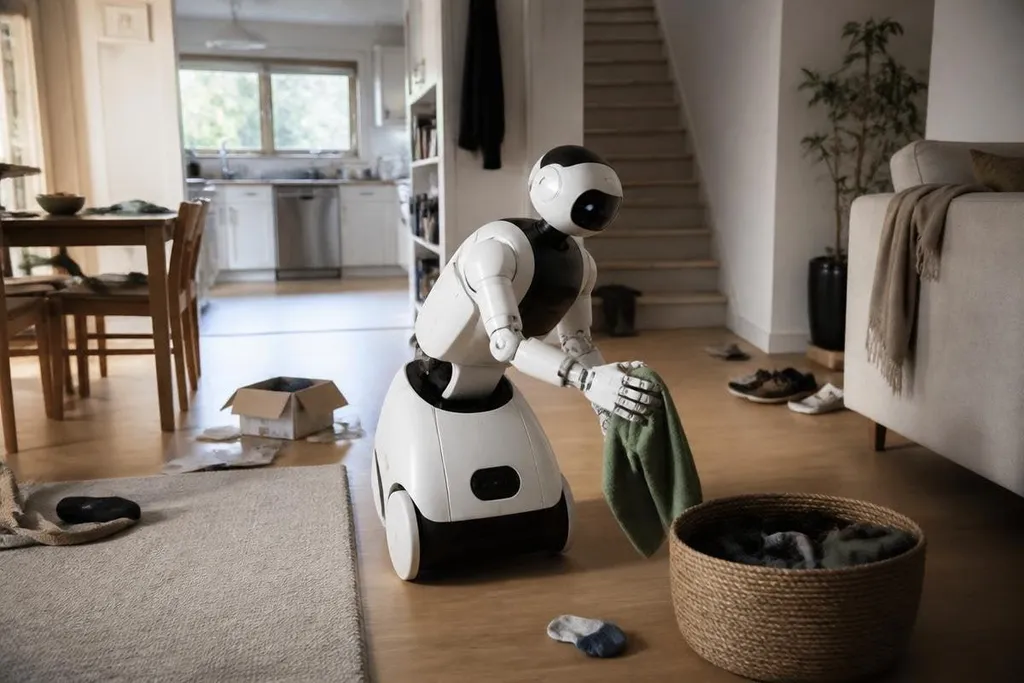
A home robot must find objects, move around people, handle loose items, plan tasks, and recover from mistakes. A machine that does one job in one room can be useful; a machine that works across a whole home faces a much harder problem.
Quick read
- Homes vary by room, so fixed paths and fixed object positions break quickly.
- Picking up a cup needs vision, motion control, and force sensing at the same time.
- A useful home robot needs safe recovery when its first plan fails.
Seeing a home is harder than seeing a test area
A robot may use an RGB camera for color images, a depth sensor for distance, or LiDAR to measure nearby surfaces. Those sensors still leave gaps. Glass can confuse depth cameras, bright windows can wash out images, and a blanket can hide the shape of an object.
The robot also has to decide what matters. A chair is an obstacle during floor cleaning, but it may be the place where someone asks the robot to put a bag. The same object changes meaning with the task.
That makes home work different from a factory station. A factory can place parts in known bins and mark safe paths on the floor. A home has cables, shoes, pets, open doors, and objects left in new places each day.
Moving safely takes more than wheels or legs
A mobile robot needs a map and a way to estimate its position inside that map. This is often called simultaneous localization and mapping, or SLAM. The robot compares sensor readings with its map as it moves, then changes its path when furniture or people block the route.
That process can fail in ordinary ways. A chair may move after the robot mapped the room. A person may stand in a doorway. A dark floor can reduce the useful detail in a camera image. The robot needs a safe stop or a new route instead of forcing the old plan.
Stairs add another problem. A wheeled robot may need a physical limit that keeps it away from an edge, while a legged robot must control foot placement and balance. Neither approach removes the need for sensors, careful software, and a safe response to errors.
Hands meet the messiest part of the problem
A robot arm can repeat a known motion with high precision. Picking up a soft shirt from a pile is different because the shirt has no fixed shape or clear handle. A cup may slide, a sponge may bend, and a thin cable may move when the gripper touches it.
The robot needs an end effector, the tool at the end of the arm, that suits the object. It also needs force sensing so it can tell the difference between touching an item and crushing it. Vision gives the robot a target, but force gives it feedback during contact.
This is why a kitchen task can take more work than a clean lab demo. The robot must find the item, choose a grip, move around nearby objects, and check whether it actually lifted the item. A failed grip needs a new attempt with a new position or force.
A missed object can turn one easy task into several new decisions. Home robotics testing and design puts those failures beside the named robot and test setting, so you can see where planning breaks before the errors stack up.
Planning breaks when small errors stack up
A request such as “put away the groceries” hides many separate jobs. The robot must identify each item, decide where it belongs, open a cupboard or refrigerator, carry the item, and confirm that the final placement worked.
A single error can change the rest of the task. If the robot mistakes a package for a bottle, it may choose the wrong grip.
An open door can also block the planned arm motion. If a person moves an item during the task, the robot has to update its plan.
The hard part is recovery. At home, the robot cannot ask a technician to reset the scene after every failed move. It needs clear limits, a way to pause, and a method for asking you a short question when the machine cannot tell what to do.
What to check before buying or backing one
Claims about a general-purpose home robot need a close look. Use this checklist when a company shows a new product or demo:
- Task scope: Check the exact jobs shown, not the broad category name.
- Human help: Ask when a person takes control and how that handoff works.
- Object range: Look for soft, thin, shiny, and partly hidden items in the test.
- Home changes: Check whether furniture, lighting, and object locations change.
- Safety response: Find out what happens when a person blocks the path or the grip fails.
- Cost details: Include setup, service, replacement parts, and any required network connection.
A general-purpose home robot can become useful through a narrow set of repeatable tasks. It still needs better handling of unknown objects, changing rooms, and failed plans before it can act as a dependable household machine. I'd wait for long, uncut tests in ordinary homes before paying for one.